

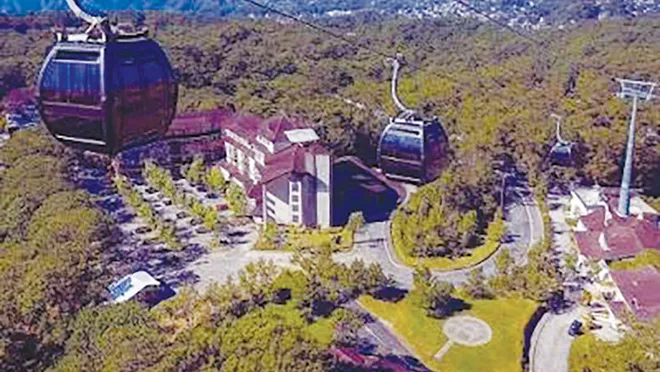
Camp John Hay in Baguio City may soon boast of the country’s first cable car system or self-driving ropeway, courtesy of the Bases Conversion and Development Authority (BCDA) through a possible joint venture with a Japanese urban transport company.
BCDA recently signed an agreement with Fukushima-based Zip Infrastructure Co. Ltd. to explore financing arrangement for the planned “Zippar” ropeway in Baguio.
In 2024, BCDA visited Japan and announced an agreement to conduct feasibility studies for the cable car project.
BCDA said the latest agreement covers plans to build a pilot line. The two parties initially targeted 2027 for the construction of the cable car system.
“The [memorandum of cooperation] will guide further cooperation on the proposed project, including feasibility studies, technical requirements, investment and financing arrangements and the potential structure of a future joint venture,” the BCDA said.
Zip claims that its self-driving cable car system can carry half the transport capacity of a conventional monorail at one-fifth the cost and construction time. Being electric and autonomous, the system is also designed to reduce carbon emissions and operating costs.
BCDA is currently looking for a consultant to prepare the detailed engineering design for an overhaul of the estate’s road and utility networks, covering roads and sidewalks, drainage and slope protection systems, streetlights, access ramps and driveways as well as road signs and pavement markings.
During the visit to Japan, BCDA also pitched projects across its other estates, particularly those within the Luzon Economic Corridor.
More than 200 Japanese investors and business executives attended the investment forum, according to the BCDA.