

By Tracy Cabrera
In the government’s quest to find renewable sources of energy, the Department of Energy has initiated a meeting with ten Norwegian energy companies to discuss ways of exploring and eventually adopting Norway’s decades of offshore wind experience that could help the country accelerate the development of a sector seen as critical to achieving long-term energy security.
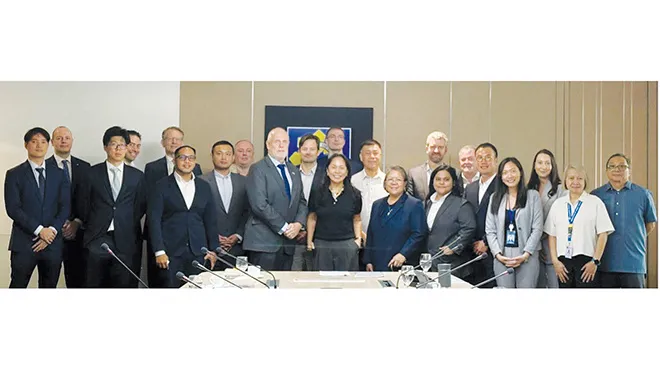
The discussions, led by energy secretary Sharon Garin, was held at the Department of Energy (DoE)’s head office in the Bonifacio Global City, where the energy chief was joined by Norwegian Embassy deputy head of mission Geir Michalsen, Norwegian Energy Partners (Norwep) director for renewable Jon Dugstad, Norwep project manager Marianne Aronsen and other officials and representatives of leading Norwegian offshore wind companies.
Also at the discussions, Garin was accompanied by undersecretaries Rowena Cristina Guevara and Giovanni Carlo Bacordo and senior trade advisor Ana Florentino.
According to Garin, the talks focused on how Norwegian technology, engineering expertise and lessons from decades of offshore development can support the Philippines as it seeks to build an offshore wind industry from the ground up.
The meeting comes as the Philippines continues to grapple with energy security concerns following the declaration of a State of National Energy Emergency earlier this year amid global fuel market disruptions and rising power demand.
“Despite having abundant renewable energy resources, we remain heavily dependent on fossil fuels. But with the prevailing energy crisis that disrupted supplies and pushed prices to almost unreachable heights, it necessitates for us to find alternative sources of energy,” the energy chief pointed out.
Based on official statistics, coal accounts for nearly 59 percent of the country’s electricity generation while natural gas contributes only about 18 percent. On the far end, renewable energy sources provide only around 22 percent even as wind and solar combined contribute a miniscule 3 to 4 percent.
“Yet we possesses one of the largest offshore wind resources in Southeast Asia,” Garin cited.
Based on DoE data and the World Bank Offshore Wind Roadmap, the Philippines has an estimated 178 gigawatts (GW) of technical offshore wind potential, with some studies placing the figure at more than 200 GW. Despite this, though, in comparison, the country currently has only about 440 megawatts of installed wind capacity, almost entirely onshore.
For Garin, where offshore wind projects could eventually provide power at a scale comparable to the country’s entire existing generation fleet, the discussions with Norway’s delegation highlighted how international partnerships may help bridge the gap between vast renewable energy potential and actual energy production.
“As we seek to diversify our energy mix and reduce dependence on imported fuels, we are viewing offshore wind not just as a climate solution, but as a strategic energy security asset,” the energy secretary stressed.